
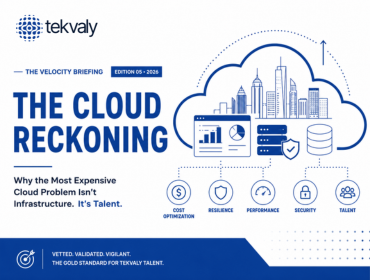
Most Expensive Cloud Problem Isn’t Infrastructure. It’s Talent.
By Tekvaly
Cloud has become the most common skill on a technical resume.
Ironically, it has also become one of the hardest capabilities to hire correctly.
Scroll through almost any shortlist today and you’ll find the same technologies repeated over and over again:
☁️ AWS
☁️ Azure
☁️ Google Cloud
☁️ Kubernetes
☁️ Terraform
☁️ Docker
Every profile appears cloud-native.
Every candidate claims cloud experience.
Yet organizations continue to face the same problems:
- Cloud bills keep rising.
- Infrastructure becomes increasingly complex.
- Reliability suffers.
- Migrations stall.
- Vendor lock-in grows.
- Engineering teams struggle to scale efficiently.
If cloud expertise is everywhere…
Why do so many organizations still fail to realize the value they expected?
Because the market has confused cloud familiarity with cloud judgment.
That distinction is quietly becoming one of the biggest competitive advantages in enterprise technology.
The Cloud Competency Illusion
For more than a decade, organizations measured cloud success by one thing:
Migration.
Moving workloads into the cloud became the objective.
The faster companies migrated, the more successful they appeared.
The industry rewarded speed.
But very few organizations stopped to ask the more important question:
What happens after the migration?
Today, cloud has evolved into permanent business infrastructure.
It powers:
- Artificial Intelligence
- Customer-facing applications
- Data platforms
- Cybersecurity operations
- Global products
- Business continuity
Cloud is no longer an IT initiative.
It has become the operating system of the modern enterprise.
Yet many organizations are still hiring for yesterday’s cloud.
They continue searching for engineers who can provision infrastructure…
…when what they truly need are architects who can optimize it.
Migration is no longer the challenge.
Operational excellence is.
The Bill Finally Arrived
For years, cloud promised a simple equation.
Move faster.
Scale instantly.
Never worry about servers again.
Organizations embraced that promise.
Now the economics have changed.
Today:
- Boards scrutinize cloud spending.
- CFOs demand measurable ROI.
- Engineering leaders are expected to justify infrastructure costs.
- FinOps has become an executive priority.
Companies are discovering an uncomfortable truth.
A surprising amount of cloud spending creates no competitive advantage.
Idle compute.
Over-provisioned clusters.
Forgotten storage.
Unused environments.
Duplicate services.
Poor architectural decisions.
Expensive egress fees.
These aren’t technology problems.
They’re judgment problems.
The engineer who can deploy infrastructure is increasingly common.
The architect who can reduce cloud costs by 40% without compromising reliability remains exceptionally rare.
That difference never appears on a certification.
It appears twelve months later…
…on the invoice.
Cloud Has Entered Its Second Era
The first era of cloud rewarded organizations for getting there.
The second era rewards organizations for using it intelligently.
Across industries we’re seeing:
✔️ Hybrid cloud strategies
✔️ Multi-cloud architectures
✔️ Cloud repatriation
✔️ FinOps optimization
✔️ Infrastructure rationalization
The conversation has shifted from:
Cloud First
to
Cloud Smart.
That shift requires an entirely different caliber of talent.
Not people who simply deploy infrastructure.
People who can redesign it.
The Scarcity Nobody Talks About
The market believes cloud talent is abundant.
Only one version of cloud talent is abundant.
People who know the platforms.
The truly scarce professionals understand something much larger.
They understand business.
Elite cloud architects don’t simply ask:
“Can we build this?”
They ask:
“Should we build it this way?”
They treat cost as a design constraint.
They understand resilience.
They balance performance against economics.
They know when complexity creates value.
More importantly…
They know when simplicity creates even more.
In technology, adding complexity is easy.
Removing it is expertise.
Why Traditional Hiring Keeps Missing Them
The hiring process still rewards visible credentials.
Resumes.
Keywords.
Certifications.
Years of experience.
None of these reliably measure architectural judgment.
A certification proves platform familiarity.
It doesn’t prove decision-making.
A resume can list technologies.
It cannot explain why one architecture succeeded while another failed.
Organizations continue screening for visible skills…
while overlooking invisible capability.
Ironically, invisible capability is exactly what determines whether cloud becomes a competitive advantage or an expensive utility.
The New Definition of Cloud Talent
Tomorrow’s cloud leaders combine multiple disciplines.
- Cloud Architecture
- Platform Engineering
- Infrastructure as Code
- Site Reliability Engineering
- FinOps
- Cybersecurity
- Observability
- Distributed Systems
- Business Strategy
They don’t simply build infrastructure.
They build businesses that happen to run on cloud.
That is no longer cloud engineering.
That is operational strategy.
The Hiring Implication
The organizations that outperform over the next decade won’t necessarily spend less on cloud.
They will simply generate more value from every dollar they spend.
Competitive advantage won’t come from choosing AWS over Azure.
Or Kubernetes over another platform.
Technology has become widely accessible.
Judgment has not.
The companies that win will identify architectural thinking long before it appears on a resume.
They will hire people capable of:
✓ Reducing cost without reducing resilience.
✓ Increasing engineering velocity without increasing complexity.
✓ Designing systems that remain adaptable as technology evolves.
The next decade of cloud won’t reward certifications.
It will reward judgment.
How Tekvaly Sees the Market
At Tekvaly, we believe cloud hiring has entered a fundamentally different phase.
We don’t evaluate candidates by counting certifications.
We evaluate how they solve production-grade problems under real-world constraints.
Can they optimize infrastructure without sacrificing reliability?
Can they balance engineering velocity with financial discipline?
Can they redesign complex environments without disrupting the business?
Can they explain not only how they built a system…
…but why they built it that way?
These are the questions that distinguish familiarity from expertise.
Whether organizations are hiring Cloud Architects, Platform Engineers, FinOps specialists, Site Reliability Engineers, or building entire cloud organizations…
We focus on one outcome:
Helping companies turn cloud infrastructure into measurable business value.
Vetted.
Technical depth.
Validated.
Proven execution.
Vigilant.
Long-term business alignment.
The Gold Standard for Tekvaly Talent.
Discussion
For CTOs, CIOs, Engineering Leaders, and Founders:
What is the biggest cloud mistake you see organizations making today?
☁️ Cloud waste?
☁️ Vendor lock-in?
☁️ Over-engineering?
☁️ Hiring engineers who know the platform but not the business?
Share your perspective below. I’d love to hear how your organization is approaching the next phase of cloud transformation.


