
The 2026 AI Talent Crisis – Why “Experience” is Now a Liability
Your AI Roadmap Is Only as Good as the Person Building It
As we move deeper into 2026, the gap between market noise and technical signal has never been wider. The C-suite is under constant pressure to deliver real, measurable ROI from AI, yet inside many organizations the engine room is slowing down. The issue is not ambition. It is talent. Most companies are still hiring based on outdated 2024 benchmarks, and that mismatch is starting to show.
In a world where the tech stack evolves every couple of weeks, a resume filled with legacy keywords is more than outdated. It signals future technical debt and inefficient capital allocation. Hiring based on what someone used to know instead of how fast they can learn is no longer viable. If learning velocity is not part of your hiring criteria, you are already behind.
The Architecture of Stagnation
The architecture of stagnation is becoming clearer across the market. Many AI strategies are not failing because of vision, but because of how talent is evaluated and deployed.
The Wrapper Trap
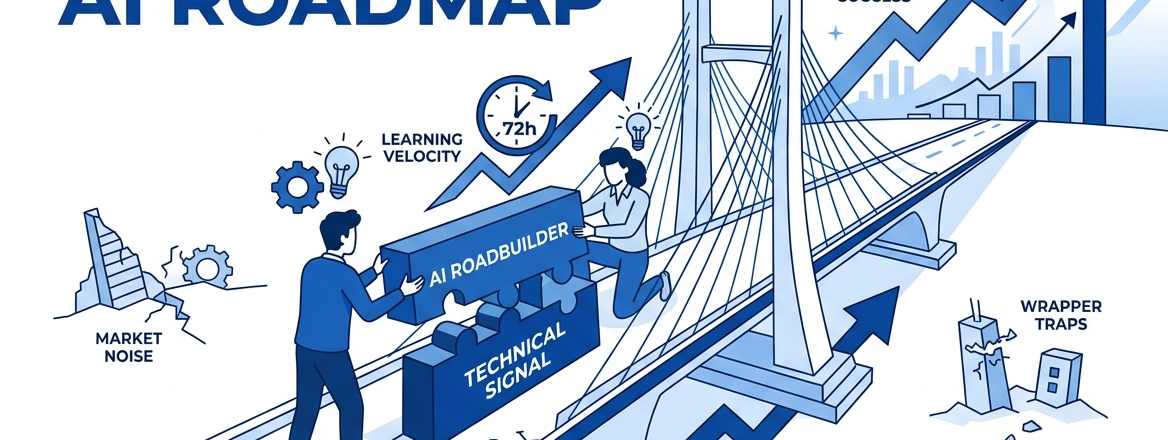
One of the most common issues is what can be called the wrapper trap. The market is saturated with professionals labeled as AI specialists who are, in reality, wrapper engineers. They know how to call APIs, build simple interfaces, and prompt large language models. What they lack is a deep understanding of the underlying systems, from model architecture to the math that drives performance. The result is a dependency on external intelligence rather than building internal capability. Companies end up renting intelligence instead of owning it. To build long-term value, organizations need engineers who understand latent space, fine-tuning trade-offs, and how to design custom agentic workflows that are proprietary and defensible.
The 72-Hour Rule
Another critical factor is the shrinking half-life of expertise. In 2026, what someone mastered last month may already be outdated. The highest-performing engineering teams operate with an internal expectation that new tools, frameworks, or systems can be understood and applied within days. This is what we refer to as the 72-hour rule. If a candidate cannot pick up a new orchestration library, vector database, or framework in that timeframe, they will slow the team down. Learning velocity directly impacts engineering velocity, and engineering velocity determines whether a roadmap moves forward or stalls.
The Vetting Gap
The third issue is the vetting gap. Traditional recruitment processes are not equipped to evaluate senior AI talent. HR teams and generalist recruiters can verify resumes and assess cultural fit, but they cannot deeply test technical reasoning or architectural decision-making. This leads to hires that look strong on paper but fail under real-world complexity. To compete at a high level, companies must shift toward validating production-grade intelligence. That means peer-to-peer technical evaluations where candidates are pushed beyond surface-level knowledge and asked to justify the “why” behind their decisions.
The Triple-V Standard
To address these challenges, a more rigorous standard is required.
At Tekvaly, the approach is built around what we call the Triple-V standard. The first layer focuses on depth. Instead of relying on standardized tests, candidates go through intensive technical discussions where their thinking is stress-tested in real time. Only a small percentage can demonstrate the level of reasoning required to handle complex systems at scale.
The second layer is validation of track record. Brand names on a resume are not enough. What matters is the ability to solve ambiguous, messy problems where there is no clear documentation or existing solution. This is where true engineering capability shows up.
The third layer is cultural vigilance. As systems become more autonomous and agent-driven, ethical alignment and operational discipline become critical. These are not soft considerations. They directly impact risk, governance, and long-term stability.
The Bottom Line: Stop Hiring for the Noise
The bottom line is simple. Companies need to stop hiring for noise.
The organizations that will lead the AI transition are not the ones chasing trends. They are the ones focused on signal. They prioritize depth over hype, learning velocity over static expertise, and real-world capability over polished resumes.
Competing for outdated talent with modern capital is a losing strategy. The future belongs to teams that can move fast, think deeply, and build systems others cannot replicate.
Founder & CTO Roundtable
The real question for founders and CTOs is this: what is the biggest AI red flag you have seen on a resume recently? Is it the rise of titles like prompt engineer, or is it the absence of true architectural thinking?
This is the conversation that matters.
Stay informed. Stay ahead.
The Tekvaly Team
Tekvaly | The Gold Standard for AI Talent
Engineering Velocity. Risk Mitigation. Operational Sovereignty.


